When the first phase of the Bacton Estate redevelopment was completed by Camden Council in 2016, it was lauded by the architectural press and others as “a superlative example of rigorous and genuine community engagement in action”. Below are three articles, sadly poignant now Camden Council has abandoned the scheme in favour of a developer-led scheme:
A report by Af Nina Tory-Henderson, published by the Danish Architecture Centre (2016)
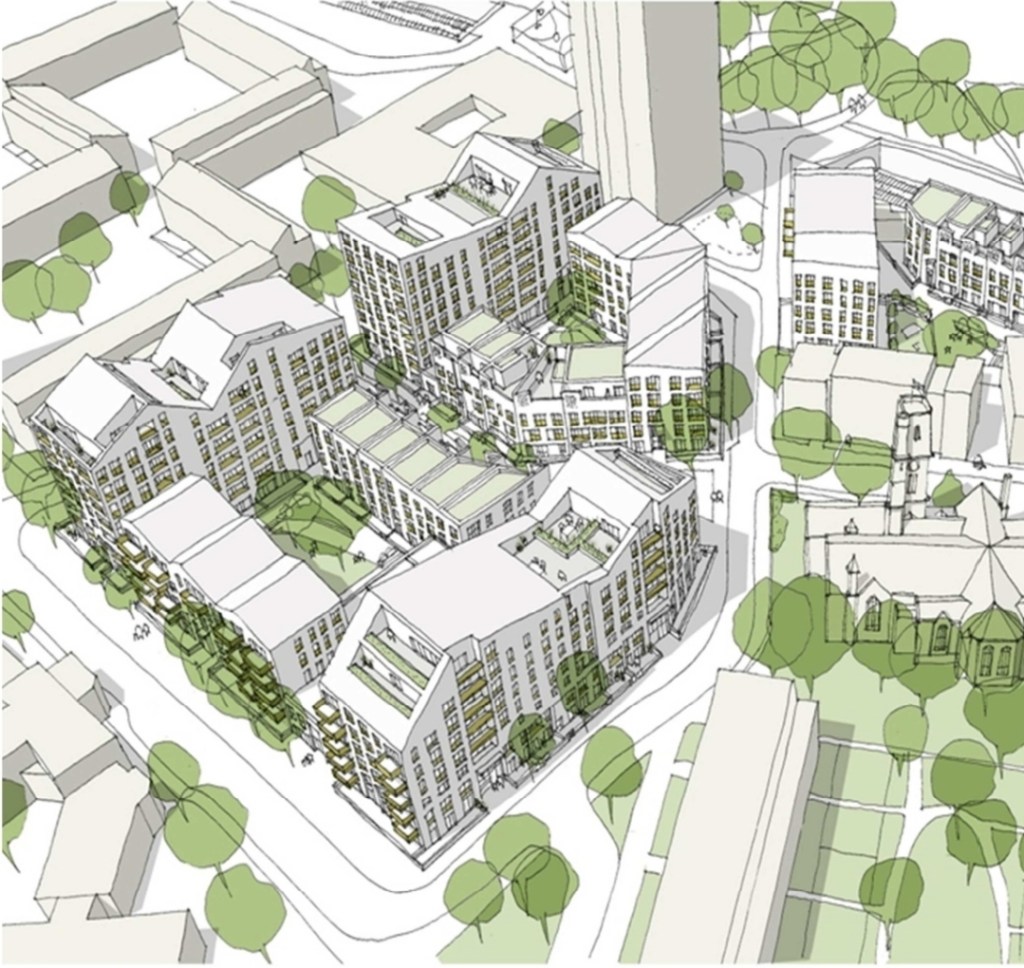
Since 2011, the London Borough of Camden, Karakusevic Carson Architects, and the residents of Bacton Estate have been working together toward an ambitious masterplan for the site’s redevelopment.
Although the built fabric of the existing estate was in poor condition, its social fabric remained cohesive – a thriving and rooted community with families reaching back four generations. The locals expressed an overwhelming desire to remain living there together, among trusted friends, family, and neighbors. The recently completed first phase of the masterplan was, therefore, a concentrated effort to provide new homes within the neighborhood prior to rebuilding the existing estate, avoiding the common ‘double decant’ situation whereby residents are forced out of their homes for long, sometimes unforeseeable periods of time during demolition and construction. In November 2015, 44 social-tenant families were rehoused in new, generous homes designed by Karakusevic Carson Architects. Phase 2 of construction, begun in 2017, will provide a total of close to 300 dwellings of mixed-tenure housing.
The Bacton Estate development is part of the London Borough of Camden’s Community Investment Programme, a response to stripped government funding that makes innovative use of council-owned land to improve public facilities. Bacton Estate is a flagship project for the program using a cross-subsidy funding model — the sale of private homes funding the new social housing. Camden Council as client and developer retains any value generated from the sale of the units, which is then reinvested back into social capital without the usual developer cut.
Camden Council & Karakusevic Carson Architects’ scheme is highly ambitious in its deliverables of liveability, sustainability, durability and exceptional public space, but its presence remains humble. The architects have worked hard toward a generous, simple and robust design for the Bacton Estate community.
To the north of the existing estate, the completed Phase 1 intelligently makes the most of its tight triangular site bordered by a railway line. Council homes of four-story terrace houses and two to three-bedroom maisonettes provide 35 – 70% additional space from London standards. Each townhouse boasts four or five bedrooms, two living areas, three bathrooms, kitchen, and dining on the first three levels, and is capped by a secluded roof terrace. Each floor is given full-height, Juliet balcony windows overlooking the south-facing communal courtyard, flooding the living spaces with natural light. Lined up along the railway in a proud row, they take their cue from traditional London townhouses with strong vertical rhythms and handsome brick facades.
Karakusevic Carson Architects specified quality, sustainable and durable materials throughout. Most notably they have championed the use of Cross Laminated Timber (CLT), which accounts for most of the structure. Although not yet widely adopted in the UK, CLT is known as ‘the engineered wood of the future’ due to its exceptional structural properties, prefabrication and therefore minimal waste and speed of construction, low-energy production processes, good thermal and acoustic performance as well as C02-absorbing and storing capabilities.
Other materials were chosen for their utility of low maintenance and durability: zinc roof panels, frosted glass balustrades, textured brickwork, solid timber & aluminum composite window frames, hardwood engineered floorboards, and ceramic tiling.
The generosity of the design continues to the site’s public spaces. A large portion of the plot is given to a central communal courtyard with the new dwellings arranged around it. Simple and delicate fin-bar steel railings contain small gardens at each terrace entrance, forming an elegant streetscape. Textured brickwork, varied openings, double-height entrance lobbies and alternating recessed and projecting balconies create stimulating and considered facades that give back to the urban realm.
The success of the Bacton Low Rise Estate redevelopment owes itself to a rigorous, transparent and inclusive design process between the architects, residents, and council. The existing community was critically engaged during all stages, with their needs and desires at the core of design decisions. Community consultation events (seven during design development and over 20 during detailed design) went above and beyond the “tick-the-box public engagement” frequently found in the architecture world. Robust dollhouse-like models were constructed for accessible communication; broad material samples were presented, through which residents could customize their individual homes; there was even a collective visit to the brick manufacturer in Belgium. Importantly, there was a focus on education through this process, including training sessions on reading architectural plans, navigating the ins and outs of complex planning processes and imparting knowledge on best practice design and construction methodologies. Following such an inclusive and collaborative process, the residents hold a strong sense of ownership, identity, and pride in the estate’s redevelopment.
Bacton Estate is a strategic, thoughtful and sensitive project in all aspects of design, funding, construction and community engagement. It is exemplary of what architecture can, and should, do.
A report by Oliver Wainwright, published by the Guardian (2016)
It’s easy to become numbed to the housing crisis, to the endless stories of councils in bed with developers, local authorities flogging off land to the private sector, of communities relentlessly trampled as luxury towers rise around them; easy to forget that “units” are people’s homes and that “community” is not something easily won, but the product of relationships forged over generations. And that both can be brutally ripped apart.
A new BBC documentary, The Estate We’re In, brings this home in harrowing detail as it follows the regeneration of one London housing estate over the course of a year. “Never in the history of social housing has so much been taken from so many by so few,” growls Jasmin Parsons, who emerges as the hero of the piece, rallying her neighbours on the West Hendon Estate in Barnet to fight against the council’s plans to bulldoze their homes.
The narrative is painfully familiar. It begins with a plan to demolish an ailing 1960s estate and replace it withnew homes at a much greater density with the help of a private development partner, Barratt. The ambition is to rehouse all residents in “like for like” new homes, with a load of private flats sold to help pay for it all. Except that, after months of putting up with construction dust and noise, the residents don’t quite get what they were promised.
“You would assume ‘like for like’ to mean a maisonette for a maisonette,” says one leaseholder on the estate, who lived in a light-flooded two-storey home with spectacular views across the neighbouring park and reservoir. “Never would you imagine that it was going to be a flat, that it would actually be smaller, and that you would only own half of it.”
Compulsory purchase order notices drop through the residents’ doors, valuing their existing flats at a fraction of what the new ones will cost – meaning they are forced to either accept a portion of a new shared ownership unit, or else move out of London altogether. Some of the social tenants, meanwhile, are rehoused in a new block called Bullfinch House (which they nickname Bullshit House). “Before, I would leave my door open and see people all the time,” says one elderly resident, in tears, sitting alone on her sofa in her brand new flat. “Now I don’t see a soul.”
Barratt declined to take part in filming, so the documentary is frustratingly one-sided. At one point it is mentioned that a large part of the estate was sold to the developer for just £3, but there is little explanation of the development agreement, nor how viability assessments were used to squeeze down the level of affordable housing. Red-faced Tory council leader Richard Corneliusis cast as the villain – “Toad of Toad Hall” as Parsons calls him – left spluttering that “there’s no public money to spend on housing, and this is a way of getting things done”.
But, just a few miles east, stands a brand new social housing block that has been built by Camden council without a private developer in sight. Marching along the edge of a railway line in Gospel Oak, with the strong vertical rhythm of a traditional terrace of London townhouses, the first phase of the Bacton Estate redevelopment stands as something of a miracle in a climate when new-build council housing has seemed impossible for so long. This is the first such housing built in the borough in almost 30 years.
“When the council said they wanted to ‘regenerate’ our estate, we never imagined we’d get anything like this,” says new resident Sarah, who recently moved into a four-storey house with four bedrooms, two living rooms, big windows and a roof terrace. Standing on her roof deck, you get a good view of one of the last great social housing programmes in the country. Across the train tracks stands a collection of mid-rise modernist blocks by some of the best architects of the 1960s and 70s – the likes of Powell & Moya, Neave Brown and Benson & Forsythe – engaged by Camden’s borough architect, Sydney Cook, in an era that saw the problem of urban housing tackled with unparalleled energy and ingenuity.
The current climate, with local authorities stripped of housing grants, might not allow anything remotely approaching this scale, but through canny cross-subsidies, Camden is giving it a go. The Bacton Estate is the first result of its Community Investment Programme, a plan to build 3,000 new homes, half of which will be affordable, using the sale of private market units to pay for new social housing – crucially without any of the value leaking into the pockets of a private developer.
The first phase has seen around 50 new social-rented units, a mixture of four-bed townhouses and two-bed maisonettes, cleverly interlocked in a handsome brick block. Walking outside her front door, which leads on to a new children’s play area, Sarah explains the scheme like an architect showing off their latest creation: “We’ve got five different kinds of brick, from the yellowish London stock, to match the buildings across the road, to a greyish colour that picks up on the stone of the nearby church, to more brownish shades matching other neighbouring estates.”
Her knowledge and enthusiasm shouldn’t come as a surprise: as chair of the tenants’ association, she’s been working on it with her neighbours for the last six years in a process that the word “consultation” doesn’t begin to describe. There were fun-days, barbecues, children’s conjurors and – most crucially – training sessions for residents to be able to understand architectural plans, and get their heads around the complex planning process. There were even trips to a Belgian factory to choose the bricks.
“We basically went to the tenants and said ‘let us bulldoze your homes’,” says Labour council leader Sarah Hayward, “which is quite a big thing to ask someone. We’re asking our residents to take a leap of faith with us, so it’s crucial they understand exactly what the choices are and how they can have an input.”
The new building – and the wider estate masterplan for almost 300 homes, currently under construction – is the work of Karakusevic Carson Architects, go-to designers for many London boroughs with ambitions to build. They are now working on several thousand council-led homes across the capital. Thatcher took away councils’ right to build but since the last Labour government passed legislation allowing local authorities to build again, momentum has been gathering on such schemes.
“Many London boroughs have been quietly getting on with it over the last few years,” says Paul Karakusevic, “building up some incredibly dynamic in-house development teams with big ambitions.” By doing it for themselves, rather than relying on private development partners, he says the boroughs can achieve more for their money. “You’re immediately cutting out the developer’s 20% profit margin, so you have an extra 20% invested in social capital rather than shareholder capital. And any value uplift is retained in the long term.”
Croydon has set up its own development company, Brick by Brick, with a target of starting construction on 9,500 homes by 2018. Newham council has established Red Door Ventures to build 3,000 homes for market rent, with profits invested into affordable housing. Its first scheme, designed by Richard Rogers, was completed last year. Islington has 2,000 affordable homes in the pipeline, Hackney 2,500 coming forward. Having had their housing hands tied for so long, local authorities are pressing forward.
But this momentum is now perilously threatened by the Housing and Planning Bill. “It cannot be stressed enough what a catastrophic result the bill would have for social housing and council-led development,” says Hayward. “The extension of right to buy, for example, would mean that we’d be forced to sell the new homes we’ve just built whenever they become vacant. It would entirely collapse our building programme.” As Karakusevic puts it: “It would be madness for the government to cut off a vital part of the housing supply chain, just when it’s got going.”
The provision of homes that are genuinely affordable to all Londoners now hangs in the balance. “You sold us a dream,” Jasmin Parsons roars at one council meeting, “which was a nightmare!” So which will the city end up with? Will it be a future of public-spirited, generously sized housing, with value retained in public hands in perpetuity, or one of meanly scaled hutches, squeezed down by the market and sold off to the highest bidder?
Bacton Low Rise: Community blessed, report in ‘Building’ magazine (2016)
The reinvention of the Bacton Low Rise council estate shows that regeneration is as much about residents as construction – and that it is better to view the local community as an asset than a hindrance. Ike Ijeh reports. Photography by Tim Crocker
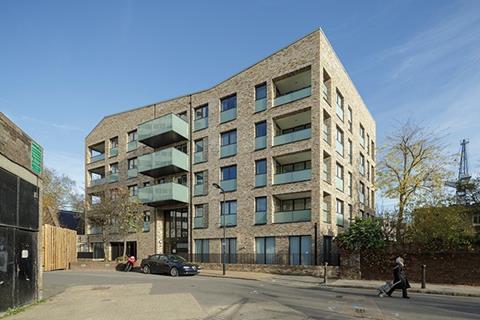
The winner of this year’s Housing Project of the Year at the Building Awards was phase 1 of the Bacton Low Rise scheme in north London by Karakusevic Carson Architects and Rydon Construction. Like many residential regeneration projects, the scheme is intended to rebuild a deprived, dilapidated inner-city housing estate by replacing old social housing units with better new ones.
Bacton Low Rise is a cut above the rest for two additional reasons. First is the exemplary quality of the new housing stock, which includes lavish social housing accommodation such as five-bed, four-storey townhouses which feature, incredibly, private roof-top terraces.
Second, the project represents a superlative example of rigorous and genuine community engagement in action. When it comes to urban regeneration, community architecture is often an oxymoron, with regeneration frequently hijacked by politicians, developers and even architects themselves, who often impose an alien and formulaic vision of improvement onto an oblivious community largely marginalised from the design process.
This is particularly the case in economically buoyant London where the rush to redevelop frequently leads to a fundamental failure of the design and developer team to sufficiently examine the innate existing community infrastructure that inevitably forms such a vital characteristic of even the most deprived areas.
But, thanks to a Herculean effort from an extraordinarily galvanised and motivated volunteer tenants’ and residents’ association (TRA) and the willingness of the client and design team to genuinely listen to and engage with them, Bacton Low Rise successfully demonstrates how a highly organised and resolutely self-empowered residential body can do as much to define the terms of the regeneration as the professionals officially tasked with delivering it.
Before it was rebuilt, the Bacton Estate comprised a series of low-rise perimeter deck access blocks, some of which backed onto the main railway line from St Pancras Station. Like so many inner London council estates, Bacton owes its existence to the Second World War. Built in the 1960s on the site of an area where buildings were almost razed to the ground by bombing, it is encircled by Gospel Oak’s grand Victorian villas, creaing a charming physical and social incongruity that remains such a distinctive part of London’s character.
The Bacton Estate itself was part of an extraordinarily ambitious programme of post-war housing commissioned by the London Borough of Camden from the 1950s onwards. Built on the site of the former William Ellis School, which was largely destroyed in the war and was relocated to nearby Parliament Hill, the estate is surrounded by other residential projects by some of the leading figures of British mid-20th century architecture, including Powell & Moya and Benson & Forsythe. However, Bacton’s cheap brick construction and dull municipal design ensured that it never matched the modernist heights of some of its neighbours.
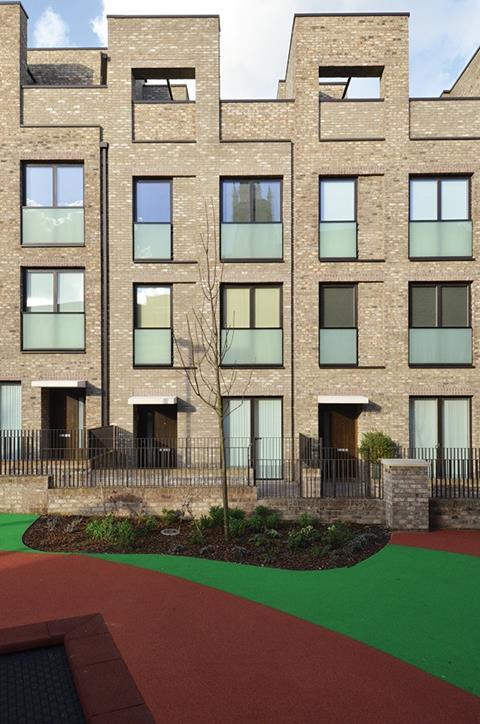
The new homes are designed to be low maintenance and include five-bed, four-storey townhouses with private roof-top terraces lavishly finished in oiled timber decking
By the 1990s, Bacton Low Rise was exhibiting the long-term problems prevalent across 1960s council estates – poor insulation, crumbling fabric, inappropriate design and high levels of anti-social behaviour facilitated by multiple deck access, compounded by a profusion of unsupervised areas such as garages and undercrofts.
To address these maladies, Camden authorised a major refurbishment between 1998 and 1999 as part of its capital works programme. Incredibly, this actually made the situation worse; quick solutions such as cosmetic over-cladding to deficient structures failed rapidly, making the problem of poor insulation worse.
In an extreme example of fuel poverty, matters deteriorated to such an extent that, before the latest rebuilding programme, residents already struggling on low incomes were complaining of staggering energy bills of up to £80 a week. Obscenely, at the same time, they were still forced to instruct their children to wear coats indoors as the heating was flowing out through the walls and windows.
It was not just energy and insulation that presented difficulties. Residents were clear where they thought the biggest problems lay – poor maintenance by the council. A common scenario provides a strong example of their gripes: because the council consistently failed to prune trees adequately, residents were forced to leave their lights on all day – which added to their fuel bills – as the trees blocked natural light from their homes.
It is this backdrop of difficulty and forbearance that helped define the design solutions developed when Rydon and Karakusevic Carson were eventually appointed to redevelop the estate in 2010. The TRA was absolutely clear about what it did and did not want.
Brickwork was a must as were sloped roofs to provide character and avoid the leakage problems that had besieged the previous flat roofs. Safe children’s play areas were also important to provide the kind of child-friendly and family-orientated environment that had been consistently suppressed by criminal and anti-social behaviour. Demolition in favour of new tower blocks was resolutely rejected, as was the council’s initial breathtaking proposal to permanently rehouse each resident almost 200 miles away in Barnsley, south Yorkshire.
The TRA was unequivocally clear about what the overriding characteristics of the new scheme should be – durable, hardwearing and made of low-maintenance materials. Conscious of the council’s previous maintenance shortcomings and wisely concluding that austerity cuts were unlikely to improve matters, the residents insisted on materials and design features that would require as little maintenance as possible.
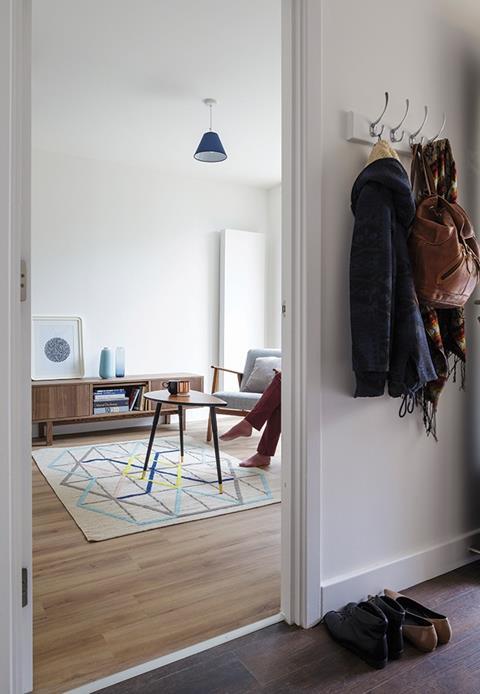
Homes are spacious and well lit with an layout options providing flexibility between open-plan and more segregated living spaces
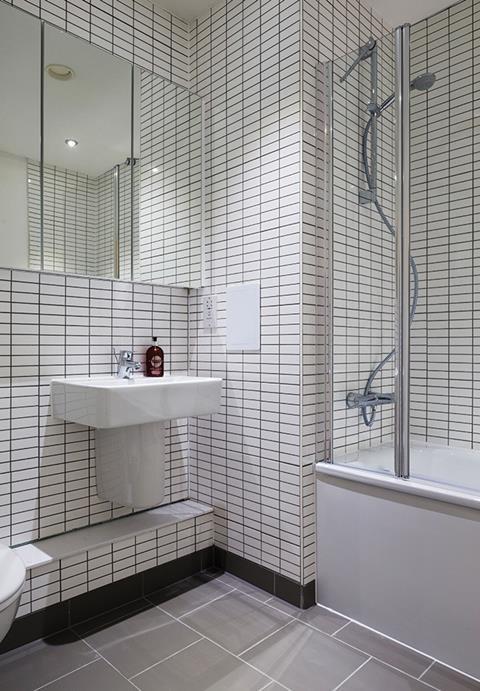
Now that the TRA had established a clear position, the next challenge was conveying it to the design team during community consultation. This process is frequently viewed as box-ticking exercise, where the risk of residents erecting unforeseen roadblocks across an preordained route must be minimised at all costs.
However, thanks to the combined efforts of both residents and the design team, community consultation at Bacton Low Rise was a masterclass in true engagement. Barbecues, fun days and family entertainment events were frequently organised, with the only proviso that residents first commented on whatever stage the proposals had reached.
The TRA was fully involved in all stages of the process, even visiting the factory in Belgium where the bricks were manufactured.
Charged by their bruising experience with the 1998 capital works refurbishment, the TRA was also crucial in the appointment of Rydon, first visiting a selection of its previous schemes as well as those of the competing bidders. The TRA reveals that while Rydon’s bid was not the cheapest, it left them most confident regarding the quality of work.
A crucial factor in the empowerment of the TRA and residents generally was the training they received from the Glasshouse Trust, a charity dedicated to providing residents with a wide-reaching range of building-related skills such as reading floorplans, scrutinising construction estimates and understanding the bewildering complexity of the planning process.
As built, the new Bacton Estate is as pure an architectural expression of the preceding consultation process as you are ever likely to find on a modern housing project. As phase 1 was built on the site of Camden’s former district housing office, the construction of this part of the estate did not require any residents to be relocated until it had been completed and they could move in, freeing much of the remainder of the site for demolition for subsequent phases.
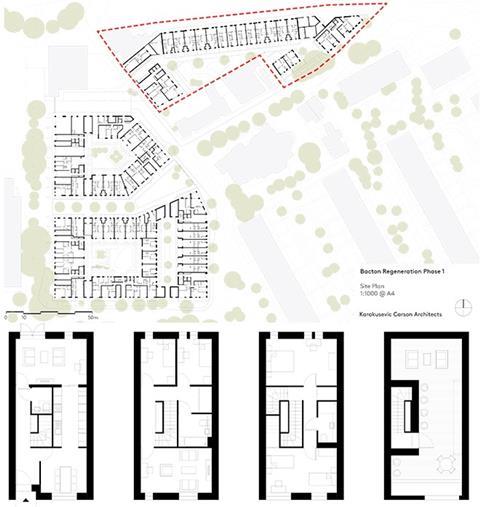
Top: The area within the red dashes is the completed phase 1 – the entire estate is due to be completed by 2017, creating 294 homes in total Bottom: Floorplans of a typical four-storey townhouse
Phase 1 includes 67 homes with three blocks arranged in a splayed formation around a triangular courtyard. Within the courtyard is the children’s play area the residents requested, now safely and directly overlooked by homes.
All three blocks are clad in brickwork flecked with grey and beige to pick up the archetypal London stock brick and the brickwork of the adjacent grade I listed St Michael’s Church. The roofscape is animated with a series of asymmetrical pitches, merging well into the local traditional townscape and dynamically avoiding the flat roofs so loathed by the residents.
Crucially, the buildings create a hard new street edge colonising the anonymous no-man’s land that is a classic feature of the 1960s housing estate with a more legible boundary presence of railings, defensible space and clearly defined entrances. Openings are treated as punched voids against the solid forms, with facades interspersed with a series of generously projecting balconies.
Internally, the units are spacious and well lit with an inventive combination of layout options providing flexibility between open-plan and more segregated living spaces. Undoubtedly the most striking features are the generous roof terraces, lavishly finished in oiled timber decking and exquisite Guzzini light brackets, a feature the design team readily admit to “fighting” for.
Clearly, the roof terraces are incorporated to provide the amenity space lost because the townhouses back onto railway tracks. Nonetheless, they speak of a level of generosity and ingenuity that is remarkable for a social housing scheme. Karakusevic Carson Architects describe Bacton Low Rise as “simple and rational with deep reveals and a strong street presence” and this is indeed what it is – a handsome contemporary extension of the London mansion block typology that utterly transforms and enhances the urban experience of a once-blighted urban site.
 West Kentish Town
2 thoughts on “Bacton Low-rise Redevelopment”